Why Learn Yoga One-on-One? A Private Yoga Lesson in Seocho
“Why do you teach yoga at a Pilates studio?” It is the question we hear most at Atelier, Mouv in Seocho. The answer is simple: for anyone who works with movement, yoga is not an option but a foundation.
Today we will talk about what kind of exercise yoga is, what effects it has on body and mind, and who should start with a private 1:1 yoga lesson, and why.
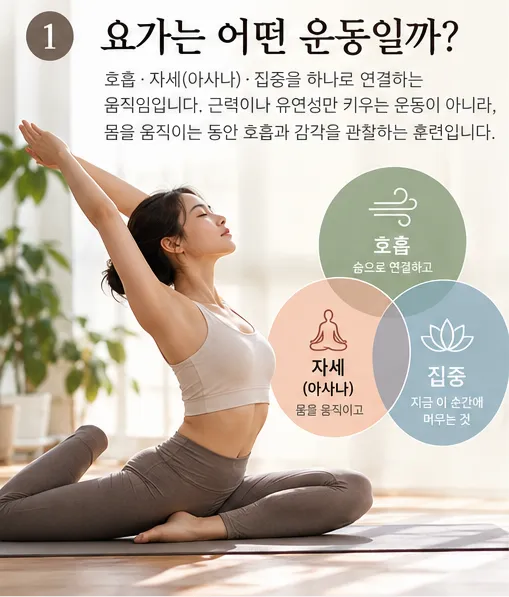
What kind of exercise is yoga?
Yoga is movement that links breath, posture (asana) and focus into one. It is not only about building strength or flexibility; it is closer to training yourself to observe your breath and sensations while you move. If Pilates deals with the precise control of the core, yoga deals with the connection and release of the whole body. When the two meet, the body finally finds its balance.
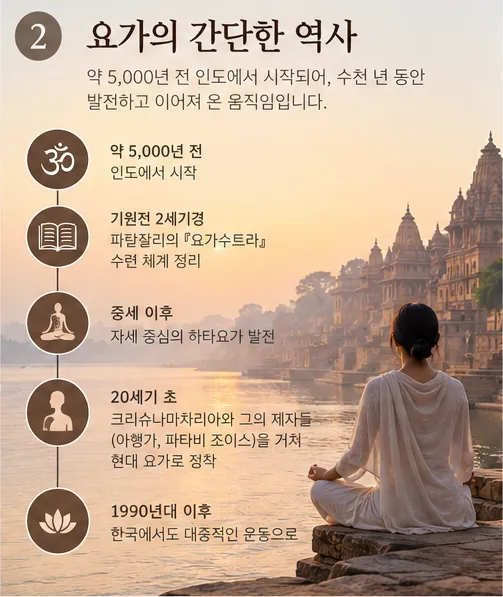
A brief history of yoga
Yoga is said to have begun in India about 5,000 years ago. Around the 2nd century BCE, Patanjali’s Yoga Sutras organized the system of practice, and Hatha yoga, which centers on postures, developed from the medieval period onward. Through Krishnamacharya and his students Iyengar and Pattabhi Jois in the early 20th century, it settled into modern yoga, and since the 1990s it has become a popular form of exercise in Korea as well. That it has survived for thousands of years says something about its value.
What yoga does for body and mind
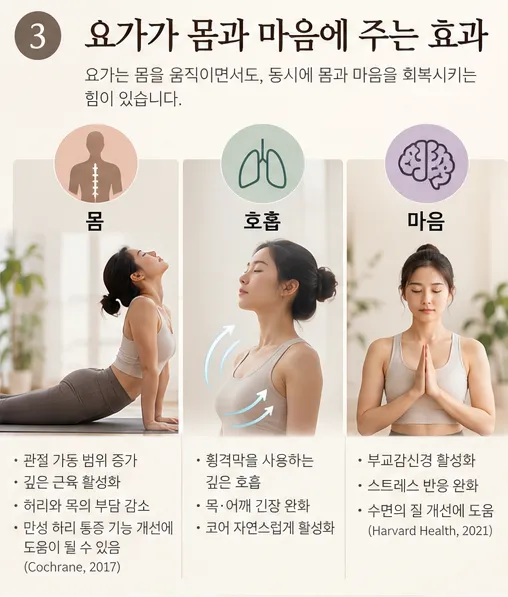
Body. Yoga postures take the joints through their full range and use the deep muscles while you hold a position. As the hip flexors shortened by long sitting and a stiff upper back loosen, the load on the lower back and neck eases. A systematic review by the Cochrane Collaboration (Cochrane, 2017) reported that yoga may help improve function in adults with chronic low back pain.
Breath. Short breaths taken high in the shoulders under tension change into deep breaths that use the diaphragm. This change alone reduces tension in the neck and shoulders and activates the core naturally.
Mind. Deep breathing and focus activate the parasympathetic nervous system and move the body into a relaxed state. Harvard Health (2021) describes regular yoga as possibly helping to ease the stress response and improve sleep quality. A mind that has been chased by work all day staying with only your own body for an hour: that is the greatest gift yoga gives.
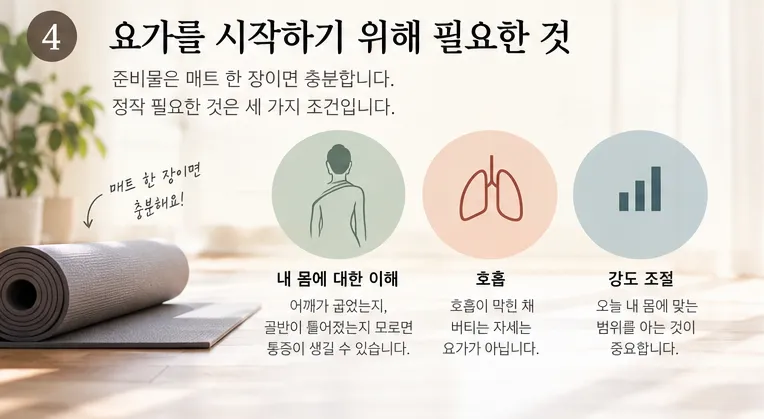
What you need to start yoga
A single mat is all you need to bring. What you really need are three conditions. Understanding your own body (if you follow along without knowing whether your shoulders are rounded or your pelvis is rotated, you may end up with pain), breath (a posture held with the breath blocked is not yoga), and adjusting intensity (knowing the range that suits your body today). These three are hard to take care of alone, or in a group class of ten.
Honestly, not everyone needs to do it one-on-one
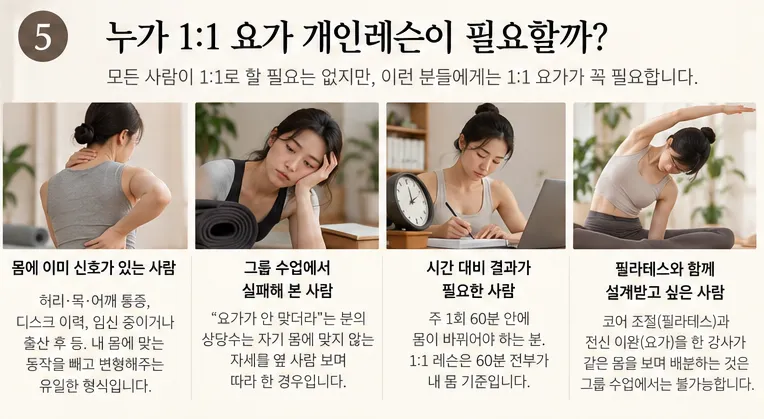
If you are healthy and have no particular problems, a group class is enough. Some people do truly need 1:1 yoga.
First, people whose body is already sending signals. Pain in the lower back, neck or shoulders, a history of disc problems, being pregnant or after giving birth. In a group class the teacher cannot see one person’s pelvic misalignment among twenty, and “rest if it doesn’t work” is the whole of the guidance. 1:1 is the only format that decides which movements to leave out and which to modify.
Second, people who have failed in group classes. Many who say “I tried yoga and it didn’t suit me” did not find yoga unsuitable; they copied the person next to them in postures that did not fit their own body.
Third, people who need results for the time they spend. Those whose body has to change within one 60-minute session a week. Of a 60-minute group class, only about 20 minutes fit your body, but in 1:1 all 60 minutes are based on your body.
Fourth, people who want a program designed together with Pilates. Having one teacher look at the same body and divide core control (Pilates) and whole-body release (yoga) between them is not possible in a group class.
This is how a private 1:1 session at Atelier, Mouv is structured.
Read the article that fits your situation
We have put together separate articles by audience: how the body breaks down and what changes in 1:1.
Office workers who sit for long hours — The body breaks down in this order: the hips lock, the back rounds, the breath becomes shallow. If your neck and shoulders feel stiff, the cause may well lie in the pelvis. We explain how to reverse that order.
People in their 40s and 50s — This is a stage when muscle mass decreases, joint range of motion narrows and recovery slows. We explain why wrists and knees get hurt in group classes set to a 20-something average, and how to start safely using props.
Pregnant and postnatal women — The joints loosen, the center of gravity shifts and the body changes every week. We explain the limits of group prenatal yoga where week 12 and week 32 do the same sequence, and how a 1:1 session is built around the pelvic floor and breath. (Please consult your doctor before exercising during pregnancy.)
In closing
Yoga is not an exercise for becoming good at it, but for becoming someone who truly knows their own body. So that you do not wander alone at the beginning, Atelier, Mouv is with you one-on-one. Your first visit starts with a movement consultation.